
17 min read
The best AI writing tools in 2026 split into two camps. Camp one: the foundational models that do the actual writing. Claude, ChatGPT. Camp two: platforms built on top of those same models, reselling the engine with a dashboard and extra buttons. Jasper, Writesonic, Copy.ai, Sudowrite, Anyword, Rytr. And then a third layer most people ignore: editing tools. Grammarly, Hemingway Editor, Wordtune. They do not generate content. They clean what already exists.
Some of these platforms solve real workflow problems. Most of them are wrappers. You should know what sits underneath before handing over $49 a month for what amounts to a skin on a $20 model. Most people never check.
What follows is not a product catalog. It is an honest breakdown of what each tool does well, where it falls apart, and who should actually be paying for it. The same approach applies here: cut the noise, keep what works.
Last updated: May 2026. Pricing, model versions, and feature availability reflect the latest confirmed information at the time of writing. AI tools change fast, so check official sites before committing to a plan.
Quick Picks
Best for writing quality: Claude Pro ($17/mo annual, $20/mo monthly). Least time between first draft and final version. Best all-in-one platform: ChatGPT Plus ($20/mo). Writing, images, research, code in one subscription. Best for marketing teams: Jasper Pro ($59/mo annual) or Business (custom). Brand voice enforcement at scale. Best for SEO and GEO tracking: Writesonic Starter ($79/mo annual). The only platform tracking AI chatbot visibility.
Best for short-form copy: Copy.ai ($29/mo). Ad headlines, product descriptions, workflow automation. Best for fiction writers: Sudowrite Professional ($22/mo annual). Story Bible, Muse 1.5, narrative memory. Best for ad conversion prediction: Anyword Data-Driven ($79/mo annual). 82% accuracy on copy scoring. Best budget option: Rytr Unlimited ($7.50/mo annual). Rough drafts at a hard-to-beat price. Best editing layer: Grammarly (free or $12/mo annual) plus Hemingway Editor (free).
Full Comparison
| Tool | Badge | Price Range | Best For | Writing Quality | Free Plan | AI Model |
|---|---|---|---|---|---|---|
| Claude | Best Overall | $0–100+/mo | Long-form writing | Highest | Yes (limited) | Claude Opus 4.7 |
| ChatGPT | Best All-in-One | $0–120/mo | Writing, images, research, code | High | Yes (with ads) | GPT-5.5 family |
| Jasper | Best for Teams | $59–69/mo+ | Brand voice at scale | Medium | No | Multi-model |
| Writesonic | Best for SEO | $79–399/mo+ | SEO + GEO tracking | Medium | No | Multi-model |
| Copy.ai | Best Short-Form | $29–custom | Ad copy + automation | Medium | No | Multi-model |
| Sudowrite | Best for Fiction | $10–44/mo | Novels + narrative | Medium-High | No | Muse 1.5 + others |
| Anyword | Best for Ads | $39–custom | Conversion prediction | Medium | No | Proprietary + GPT |
| Rytr | Best Budget | $0–29/mo | Volume drafts | Low-Medium | Yes | Multi-model |
| Grammarly | Best Editor | $0–30/mo | Grammar + tone polish | N/A (editor) | Yes | Proprietary |
| Hemingway | Best Readability | $0–25/mo | Sentence clarity | N/A (editor) | Yes | N/A |
The Two That Actually Matter
Claude (Anthropic)
Best for: Long-form writing, editorial content, minimal revision cycles
Claude does one thing better than every other tool on this list. It writes sentences that do not make you wince.
Generate content across different platforms and the same fingerprints surface everywhere. Hedging language. Filler transitions. That habit of restating what was just said in slightly different words. Claude does less of it. The first draft already comes closer to something you would actually put your name on.
Opus 4.7 runs a context window up to 1 million tokens with 128K output capacity. Full report sections or chapter drafts without the model hitting a ceiling mid-thought. Pro runs $17/mo on the annual plan ($200 billed upfront) or $20/mo monthly. Max starts from $100/mo with 5x or 20x Pro usage. Teams cost $20/seat/mo annual ($25 monthly) for standard seats, $100/seat/mo annual ($125 monthly) for premium seats with 5x usage.
Long-form consistency is where Claude separates itself. Tone memory that holds across thousands of words. Narrative coherence that persists between sessions through Projects.
No image generation. No built-in web browsing in the standard interface. No video. Claude does not try to be everything. It only writes. If that is not enough, look at ChatGPT. But if clean prose matters more than feature breadth, nothing else here closes the gap between a raw draft and something ready to post.
Strengths: Highest sentence-level quality, long-form tone consistency, 1M token context window, persistent memory through Projects. Weaknesses: No image generation, no built-in browsing, no video. Writing only.
ChatGPT (OpenAI)
Best for: All-in-one workflows (writing + images + research + code)
ChatGPT writes clean, well-organized content. Structure is immediately legible. But the rhythm locks in fast: short declarative sentence, then explanation, then repeat. Predictable. The transitions feel controlled rather than confident.
The current lineup runs on the GPT-5.5 family, including GPT-5.5 Instant for lighter tasks, GPT-5.5 Thinking and GPT-5.5 Pro for heavier reasoning, and GPT-5 Thinking Mini as the compact option. The repetition problems that plagued earlier versions in long-form content are mostly gone.
Browsing integration lets you research and draft in the same conversation. Canvas puts writing and iteration into a side panel editor. Image generation, Deep Research, and Code Interpreter all run inside one subscription.
Plus at $20/mo gets you the full package. Go at $6/mo works for lighter usage. Pro at $120/mo removes nearly all limits and unlocks ChatGPT Pulse. Business runs $20/user/mo (annual) for teams. Enterprise goes custom.
The breadth is real. For teams that need writing plus images plus research plus code, nothing else covers that range in a single subscription. But the writing itself stays competent without becoming memorable. The same transition phrases surface across different prompts, the same cadence settles in, a rhythm that repeats until you start skimming.
Past 3,000 words, structural clean-up becomes unavoidable. Writers who care about sentence-level quality will spend more time editing ChatGPT output than Claude output. That is the trade-off for getting everything else in one place.
Strengths: Broadest feature set in one subscription, Canvas editor, image generation, Deep Research, Code Interpreter, browsing integration. Weaknesses: Predictable writing rhythm, repetitive transitions in long-form, structural clean-up needed past 3,000 words.
Best AI Writing Tools for Specialized Workflows
Jasper
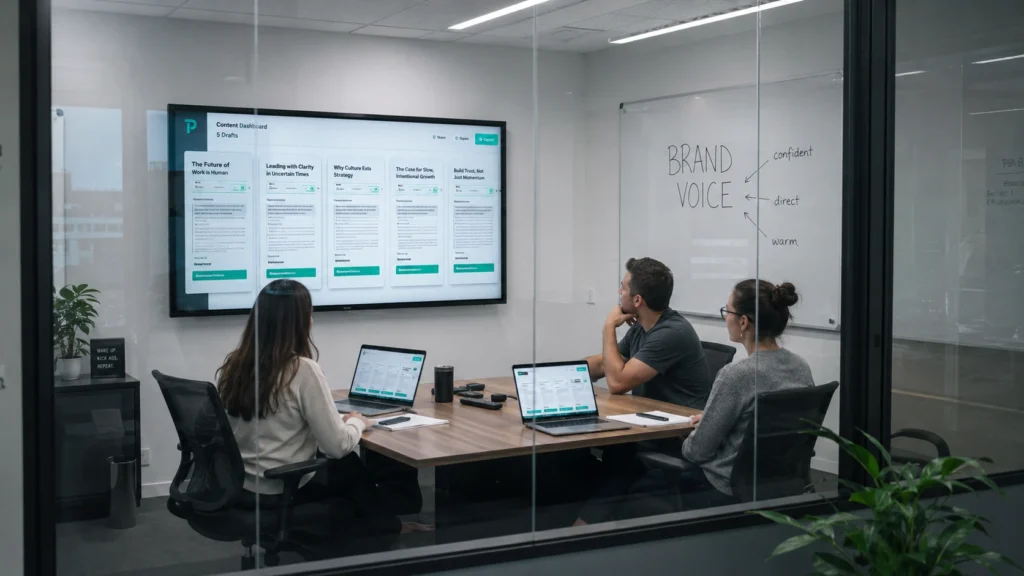
Best for: Marketing teams needing brand voice consistency and workflow coordination
Most people do not need Jasper. Jasper’s price tells you who it is for: marketing teams with budgets and coordination problems, not solo bloggers.
Brand voice controls, approval workflows, team-wide consistency settings exist to solve organizational friction. Pro at $69/mo ($59/mo annual) opens 1 seat with Brand Voice, Jasper IQ, AI agents, and image generation. Business runs custom with unlimited seats and API access. The 2025 update added an Optimization Agent with dynamic model selection across OpenAI, Anthropic, and Google Vertex AI.
Output quality does not justify the premium over ChatGPT Plus. You are paying for the organizational layer, not better prose. Solo creators: if you are one person, the upgrade from ChatGPT Plus is not worth $39 extra. Save your money.
Strengths: Brand voice enforcement, approval workflows, Optimization Agent, multi-model selection. Weaknesses: Forgettable prose quality, overpriced for solo users, output no better than ChatGPT Plus.
Writesonic
Best for: SEO and GEO tracking, content production at speed
Writesonic stopped pretending to be a writing tool. It is a content production pipeline with SEO and GEO baked into every step.
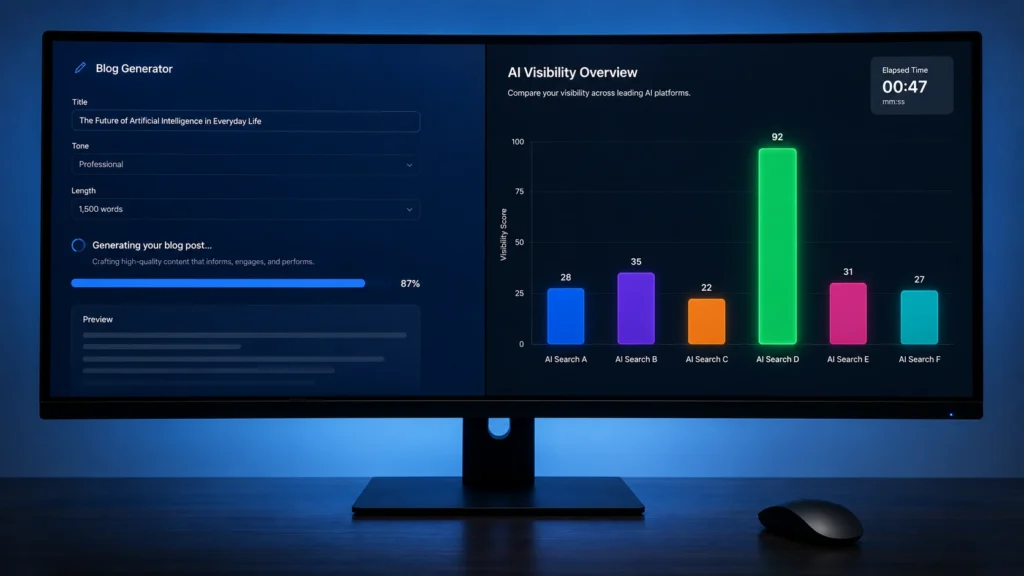
The 2026 differentiator: GEO tracking. Writesonic now tracks how AI chatbots represent your brand across up to 10 platforms (ChatGPT, Perplexity, Gemini, Claude, Grok, DeepSeek, Microsoft Copilot, Meta AI, Google AI Mode, and Google AI Overviews). With AI Overviews appearing on a growing share of search results, tracking visibility beyond organic links is no longer optional. No other writing platform offers this.
Pricing splits into two tracks: For Brands and For Agencies, each with monthly and annual billing (annual saves 20%). For Brands, Starter runs $79/mo (annual) tracking ChatGPT only, Basic at $199/mo adds Gemini and Google AI Overviews, Growth at $399/mo (annual) opens sentiment analysis and Action Center.
Enterprise goes custom with all 10 AI platforms. For Agencies, Agency Starter costs $200/mo (annual) with pitch project audits for up to 20 clients, Agency Enterprise runs custom with white-label reporting and full platform access. The writing is flat. Publishable with editing, nothing you would read twice. This is a visibility tracking platform now, not a writing tool.
Strengths: Only platform with GEO tracking, fast content production, affordable entry price. Weaknesses: Flat writing quality, outputs sound similar across topics, not built for prose.
Copy.ai

Best for: Short-form marketing copy, workflow automation
Copy.ai figured out what it was faster than most. Short-form marketing copy: ad headlines, product descriptions, email subject lines, social media captions. Nothing longer.
Workflow automation chains steps together: take a product URL, extract features, generate five ad variations, create matching social posts, output everything structured. Twelve headline options for A/B testing in minutes. The Chat plan runs $29/mo ($24/mo annual) with 5 seats, unlimited words, and unlimited chat projects. Growth at $1,000/mo annual opens workflow credits for 75 seats. Enterprise goes custom with API access, bulk workflow runs, and dedicated support.
The jump from $29 Chat to $1,000 Growth is steep, and enterprise pricing sits behind sales calls. Anyone writing long-form content: wrong tool entirely.
Strengths: Fast workflow automation, structured output, strong for A/B testing ad copy, 5 seats included. Weaknesses: Steep jump from $29 Chat to $1,000 Growth, useless for long-form, enterprise pricing behind sales calls.
Sudowrite

Best for: Fiction writers, novelists, long-form narrative projects
Sudowrite exists for fiction. Novelists building narratives across tens of thousands of words where a character forgetting their own backstory in chapter twelve ruins everything.
Story Bible holds characters, locations, plot threads, voice rules, and world mechanics in context. Muse 1.5, their proprietary model fine-tuned on published novels, handles scene blocking and dialogue rhythm in ways general models miss. Hobby & Student at $19/mo ($10/mo annual) with 225,000 credits. Professional at $29/mo ($22/mo annual) with 1,000,000 credits. Max at $59/mo ($44/mo annual) with 2,000,000 credits and 12-month rollover.
No export to PDF or EPUB. Baffling for a tool aimed at authors who need to submit manuscripts. If your writing does not have characters, Sudowrite has nothing for you.
Strengths: Story Bible narrative memory, Muse 1.5 fine-tuned for fiction, character consistency across long projects. Weaknesses: No PDF/EPUB export, useless for nonfiction, zero marketing or SEO features.
Anyword
Best for: Paid ad copy optimization, conversion prediction
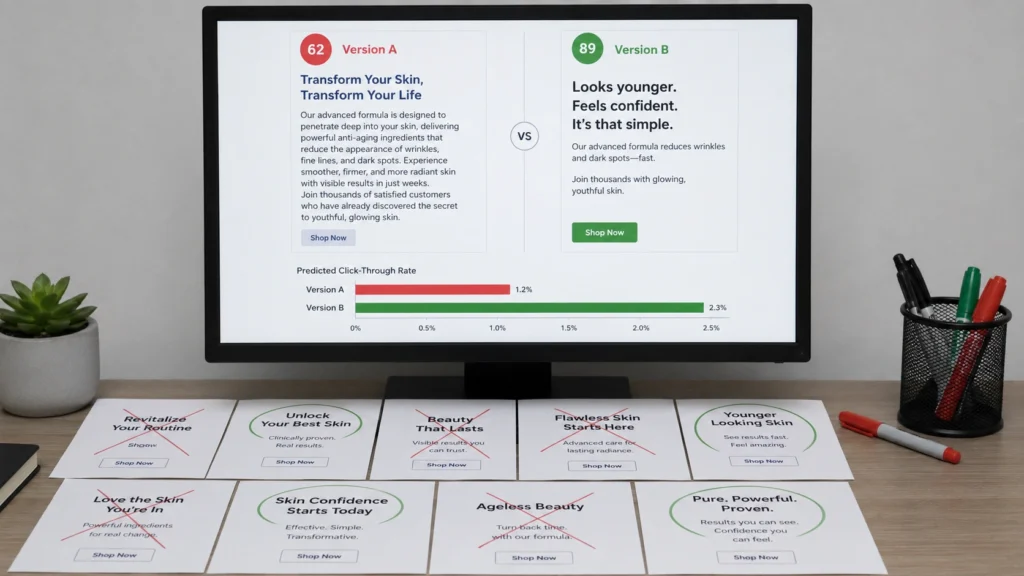
Anyword does not make your writing better. It tells you which version will probably convert better. The prediction engine, trained on $210 million in real ad spend data, claims 82 percent accuracy on copy scoring versus 52 percent from general models. Starter at $49/mo ($39/mo annual) with 1 seat and 50 performance predictions. Data-Driven at $99/mo ($79/mo annual) with 3 seats and expanded prediction capacity. Business and Enterprise run custom pricing.
If you do not run paid campaigns, the prediction engine has nothing useful to predict.
Strengths: 82% accuracy on copy scoring, trained on $210M real ad spend, clear ROI math. Weaknesses: Useless without ad spend, writing quality is not the product, narrow use case.
Rytr
Best for: Budget-conscious writers who need volume over polish
The budget pick. Free plan gives 10,000 characters. Unlimited runs $9/mo monthly or $7.50/mo on the annual plan. Premium at $29/mo monthly or $24.16/mo annual adds AI images, multiple tone match, and priority support.
Writing quality sits below Claude and ChatGPT. Not terribly below, but relevantly. The outputs feel over-engineered for simplicity: short sentences that sound punchy but say nothing, transitions that connect paragraphs without adding meaning. You will edit more. Whether you want creative volume on a budget or just a starting point to rewrite from, Rytr gives you the blank page at a price hard to argue with. Do not expect to publish without serious revision time.
Strengths: Cheapest option with a usable free tier, 40+ use cases, fast output. Weaknesses: Below-average writing quality, heavy editing required, punchy-but-empty sentences.
The Editing Layer
Every AI model produces errors. Awkward constructions, inconsistent tone shifts, grammar issues spell-check systems ignore. These tools do not generate content. They clean it. Skipping this step is how AI-assisted content gets detected, and once readers suspect it, they stop trusting the site. Publishing without an editing pass is how careless content enters the world.
Grammarly is the final pass. Free plan catches basics. Pro (formerly Premium) at $12/mo annual or $30/mo monthly adds tone detection, clarity, plagiarism, and style guides. Six tone options and three formality levels. It will not make bloated prose sharper, but it will keep you from looking careless.
Hemingway Editor does exactly what the name promises. Free in the browser, $19.99 one-time for Desktop without AI features, or Plus starting at $8.33/mo annual ($25/mo monthly) for AI-powered sentence rewrites. Highlights passive voice, overcomplex sentences, adverb overuse. Five minutes, paste in, fix flagged sections, paste out. Catches exactly the problems AI writing creates most often.
Wordtune rewrites content you have already written. Shorter, longer, formal, casual. Free tier gives limited daily rewrites. Advanced at $4.89/mo annual ($6.99/mo monthly) opens 30 rewrites daily. Unlimited at $6.99/mo annual ($9.99/mo monthly) removes all caps. Useful for non-native English writers who want natural fluency without losing original meaning.
How to Pick the Right AI Writing Tool
Sentence-level quality matters most: Claude Pro ($17/mo annual, $20/mo monthly). Fewest revision rounds before publish. Nothing else comes close.
One subscription, no decision fatigue: ChatGPT Plus ($20/mo). Writing plus images plus research plus code. Or Go ($6/mo) if usage is lighter.
Marketing teams with brand consistency problems land at Jasper Pro ($59/mo annual) or Business (custom). Solo users should not apply.
Rankings and traffic over prose quality: Writesonic Starter ($79/mo annual) for ChatGPT-only tracking, Basic ($199/mo annual) for Gemini and AI Overviews, or Growth ($399/mo annual) for sentiment analysis and Action Center. Agencies get a separate pricing track starting at $200/mo annual.
Ad headline variations in five minutes: Copy.ai ($29/mo, 5 seats). Do not use it for anything over 500 words.
Fiction writers have exactly one option: Sudowrite Professional ($22/mo annual). Story Bible and Muse 1.5. No real alternative exists.
Paid campaigns with real budgets: Anyword Data-Driven ($99/mo, or $79/mo annual). Not spending on ads? Skip it.
Tight budget, flexible standards: Rytr Unlimited ($7.50/mo annual). Edit more, spend less.
Regardless of what you pick: add Grammarly (free or $12/mo annual) plus Hemingway Editor (free). They catch what every AI model produces. Combined cost less than any single platform on this list.
What Most Comparisons Leave Out
The majority of dedicated AI writing platforms resell the same models you can access for $20. You are paying $29 to $199 for a better-designed interface on a model that costs a fraction of that. Sometimes the interface justifies the price. Sometimes you just bought a dashboard.
Jasper’s team features solve coordination problems. Writesonic’s GEO tracking provides data nobody else offers. Copy.ai’s workflow automation chains tasks that would take manual prompting across ten minutes. These are real reasons to pay a premium. Make that decision knowing what is underneath, not what the marketing page shows.
Every tool on this list still needs a human between the draft and the publish button. The real question is how much work that human has to do. Claude shrinks that gap the most. ChatGPT takes more rounds to get there. Everything else adds workflow features on top of roughly similar raw output.
Which AI writing tool is best for long-form content?
Claude. Opus 4.7 produces drafts that need the fewest revision passes before they are ready to go live. Output capacity reaches 128K tokens, and tone stays stable across long documents where other models start drifting.
What is the best free AI writing tool?
Claude Free and ChatGPT Free both offer solid output. Claude Free has limited daily messages but cleaner sentence structure. ChatGPT Free includes ads (US only) and caps usage with GPT-5.5 Instant. For post-draft cleanup, Grammarly Free and Hemingway Editor (browser version) cost nothing and catch the mistakes every model makes.
Is Jasper worth it for a solo writer?
No. Jasper’s value is brand consistency enforcement across teams. A solo writer using Claude or ChatGPT at a lower price gets the same or better output. The organizational layer is what you pay for, not the writing.
Which AI writing tool is best for SEO?
Writesonic, specifically for its GEO tracking that monitors how AI search engines represent your content. Traditional SEO is not enough anymore. Writesonic tracks visibility across up to 10 AI platforms including ChatGPT, Perplexity, Gemini, Claude, Grok, DeepSeek, Microsoft Copilot, Meta AI, Google AI Mode, and Google AI Overviews. Pricing runs from $79/mo (annual) for Brands and $200/mo (annual) for Agencies.
Can AI writing tools replace human editors?
No. None of these tools produce publishable copy without human editing. They reduce the distance between a blank page and a finished draft, but the final pass (tone, accuracy, structure, voice) still requires a human. Adding Grammarly and Hemingway Editor to any AI writing workflow catches the most common problems for under $12 a month.
Where the Cursor Lands
Claude, ChatGPT, and a free editing layer. That combination costs less than most single-platform subscriptions and produces better results than most $99/mo platforms. Beyond that, the most useful additions are not more AI writers. They are editing tools. Grammarly for errors, Hemingway for readability. Those two together cost less than any single platform here and improve the output of all of them.
The core strengths and weaknesses of these tools rarely shift as fast as their pricing pages suggest. Pick what you actually need, not what impressed you during a free trial. The best AI writing tool is the one you stop noticing because it does what you need without getting in the way.