

9 min read
Starting digital art often looks simple from the outside, but in practice it feels heavier than expected. Not because drawing is impossible, but because the beginning is filled with too many decisions.
Too many devices, too many apps, too many tutorials. Instead of helping, all of this slows things down. Before learning how to draw, beginners often get stuck trying to choose the “perfect” setup.
This guide focuses on removing that confusion and turning the process into something clear and repeatable.
Why Beginners Get Stuck So Early
Most beginners do not fail because they lack talent. They get stuck because the entry point is disorganised.
Digital art introduces many variables at once: hardware, software, layers, brushes, references, anatomy, perspective. A beginner who has not yet learned how to control simple forms is suddenly expected to manage all of them.
The issue is not difficulty. The issue is timing.
When the number of decisions is reduced, progress becomes easier to see and repeat.
What Digital Art Actually Is
Digital art is not a shortcut around drawing. It is simply a different environment.
The core skills remain the same:
form
proportion
structure
light
The core skills of drawing, such as form, proportion, and light, are widely recognised as the foundation of visual art, as also described in Britannica’s drawing overview.
Software can support the process, but it cannot replace these fundamentals. Beginners often focus too much on tools and not enough on what actually builds control.
Understanding this early prevents unnecessary confusion later.
Simple Setup for Beginners

Starting digital art does not require a complex setup, and trying to build one too early often slows down progress instead of helping it. A single device is enough, and one drawing application is more than sufficient to begin. What matters here is not variety, but stability. When the tools remain consistent, attention shifts naturally toward learning rather than constant adjustment.
For most beginners, the real problem is not access to tools, but too many options. Switching between devices, testing different applications, or searching for better settings interrupts the learning process. Instead of improving drawing skills, time gets spent on decisions that do not directly contribute to progress.
A single drawing application such as Krita or Procreate is more than enough to begin. Instead of switching between multiple tools, staying with one consistent setup helps build control and clarity over time.
Keeping the setup simple removes this friction. One device, one application, and a stable routine create a controlled environment where improvement becomes easier to track. When the setup stays unchanged, even small progress becomes more visible, and the learning process feels less overwhelming.
The Right Learning Order: What to Learn First
The goal at the beginning is not style. It is control.
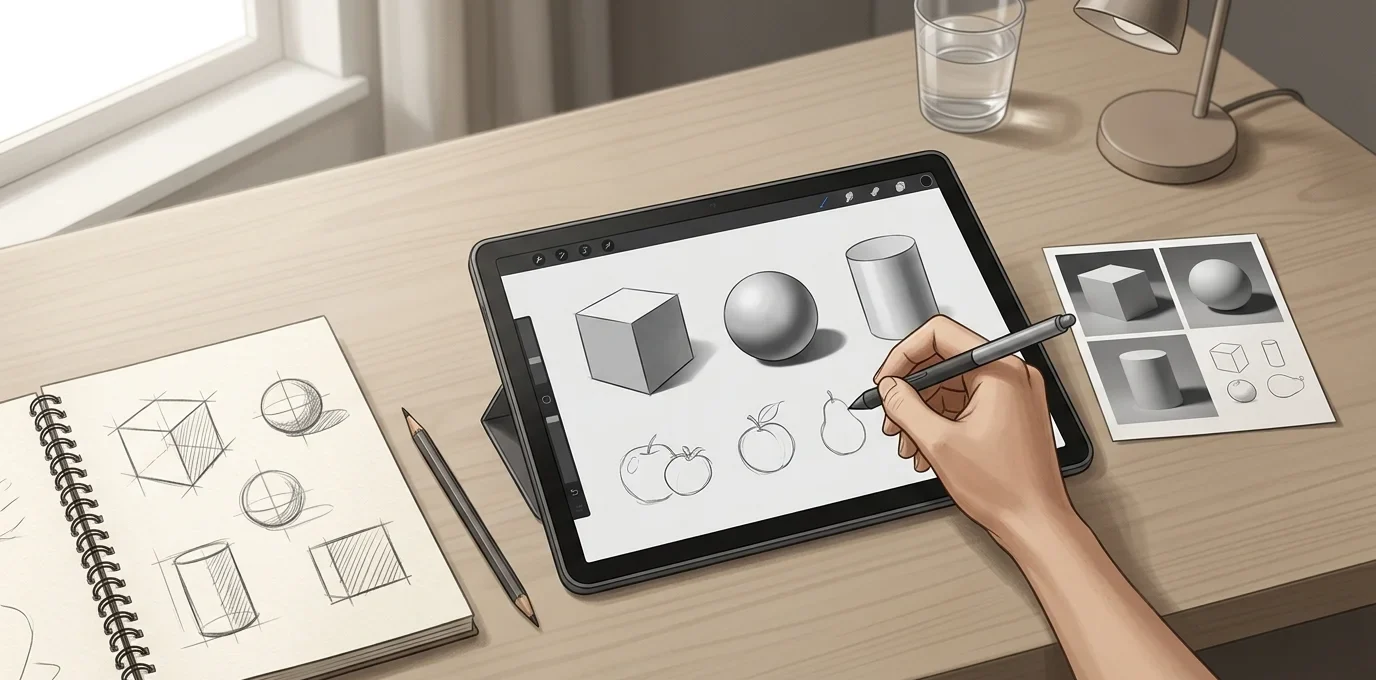
Step 1: Learn shapes and simple forms
Boxes, spheres, cylinders. These teach structure.
Step 2: Learn proportion and placement
Train your eye to compare size and distance.
Step 3: Learn value before colour
Separate light and shadow clearly.
Step 4: Simplify real objects
Use everyday objects to see mistakes more easily.
Step 5: Finish small pieces
Completion teaches decision-making.
Week Beginner Plan
The first week should not be treated as a series of separate daily goals, but as a continuous process built on repetition. Instead of trying to learn something new every day, it is more effective to stay close to the same fundamentals and approach them from slightly different angles.
At the beginning, the focus remains on simple forms—basic shapes, clean lines, and controlled strokes. These are not temporary exercises, but the foundation of everything that follows. Repeating them across the first few days is not a limitation; it is what allows the hand and eye to start working together more naturally.
As the week progresses, the structure does not become more complex, but more stable. Small adjustments begin to appear—lines become more intentional, shapes feel more consistent, and observation becomes slightly sharper. This shift is often subtle, but it is the first sign of real progress.
Rather than measuring improvement by the number of drawings produced, it is more useful to look at control and clarity. Even within a single week, a stable routine built on repetition can create noticeable change, as long as the focus remains on understanding rather than speed.
A Practice System That Actually Leads Somewhere
Many beginners spend time drawing regularly but see limited improvement, not because they lack effort, but because their practice lacks structure. Without a clear system, repetition often turns into habit rather than progress.
A useful approach is built on three connected parts: observation, control, and application. These are not separate exercises, but stages that support each other within the same process.
Observation focuses on understanding what is being seen. Instead of drawing immediately, attention is directed toward form, proportion, and light. This step builds clarity before any action is taken.
Control develops the ability to translate that observation into marks. Simple lines, shapes, and controlled movements help reduce inconsistency and improve accuracy over time.
Application brings these elements together. Drawing becomes more intentional, as it builds on what has already been observed and practiced, rather than relying on guesswork.
When one of these parts is missing, the process becomes unbalanced. Observation without control leads to hesitation, control without observation leads to mechanical repetition, and application without both results in confusion.
Keeping these elements connected creates a system where each session contributes to gradual, visible improvement.
Structured learning can also help beginners stay consistent, and platforms such as Coursera offer introductory courses that explain the fundamentals step by step.
Practice Session Structure

A practice session works best when it follows a consistent rhythm rather than relying on motivation alone. Without a clear structure, practice often turns into repetition without direction, which slows down improvement instead of supporting it.
It usually begins with a short warm-up, where simple lines or basic shapes help establish control and reduce stiffness. This stage is not about accuracy, but about preparing the hand to move with more intention.
From there, the session shifts into a more focused observation phase. Attention is directed toward a specific element, such as form, proportion, or light. The goal here is not to produce a finished drawing, but to understand what is actually being seen before trying to interpret it.
Only after this does the process move into application. Drawing at this stage becomes more deliberate, as it builds directly on what was just observed rather than relying on guesswork. This is where understanding begins to translate into control.
When this structure is repeated over time, even short sessions become more effective. Without it, practice tends to feel active but produces limited progress. With it, small improvements start to accumulate in a way that becomes visible and easier to sustain.
How to Use Reference Properly
Using reference effectively is not about copying what you see, but understanding how it is constructed. Without this distinction, reference can easily become a shortcut instead of a learning tool.
Before starting a drawing, it helps to simplify the subject into its main structure. This means identifying the basic shapes that define the form, rather than focusing on details too early.
From there, attention shifts to the main angles. These angles determine the overall direction and balance of the drawing. When they are correct, the structure feels stable even before any refinement is added.
Light direction comes next. Understanding where the light is coming from helps define volume and makes the form easier to read. Without this step, drawings often feel flat regardless of detail.
Only after these elements are clear does it make sense to move into detail. Starting with detail too early usually leads to confusion, because there is no solid structure to support it.
When reference is used this way, it becomes a tool for understanding rather than copying. Over time, this approach makes observation more precise and drawing more controlled.
Common Beginner Mistakes
Many beginner mistakes are not caused by lack of effort, but by focusing on the wrong things too early. Recognising these patterns makes it easier to adjust the process and avoid unnecessary frustration.
Starting with detail before structure
Focusing on small details too early often leads to unstable drawings. Without a clear underlying structure, details do not have a solid base to support them.
Weak proportion
When proportions are off, even well-rendered drawings feel incorrect. Understanding how parts relate to each other is more important than refining individual elements.
Unclear light
Without a clear light source, forms appear flat and disconnected. Light is what gives volume and depth, and it needs to be consistent throughout the drawing.
Switching tools too often
Changing brushes, apps, or devices too frequently interrupts learning. Consistency in tools allows focus to remain on skill development rather than constant adjustment.
Avoiding finished work
Stopping before completing a drawing prevents understanding the full process. Even imperfect finished pieces provide more insight than multiple unfinished attempts.
When these problems are recognised early, improvement becomes more manageable. Instead of guessing what went wrong, the process becomes clearer and easier to adjust over time.
Learning Colour Without Getting Lost
Colour often feels confusing at the beginning, not because it is inherently complex, but because it is introduced too early. Without a clear understanding of value, colour has no structure to follow, which makes everything feel uncertain.
When value is already understood, colour becomes easier to organise. Instead of guessing, decisions start to follow a visible logic. Light and shadow define the form first, and colour begins to support that structure rather than replace it.
A limited palette helps keep this process controlled. Working with fewer colours reduces unnecessary choices and makes relationships between tones easier to see. This simplicity allows attention to stay on observation rather than experimentation.
Over time, colour stops feeling overwhelming and becomes something that can be adjusted with more confidence. What once felt unpredictable starts to follow a clearer direction, built on the foundation that was already established.
Final Thoughts
At the beginning, digital art often feels complicated not because it is difficult, but because it is approached without structure. When too many decisions are introduced too early, the process becomes harder than it needs to be. Reducing that complexity is what allows progress to begin.
A simple and repeatable system does not limit creativity; it supports it. By focusing on fewer elements at a time, each stage becomes clearer, and improvement becomes easier to recognise. What once felt uncertain starts to follow a more predictable direction.
Progress in this space is rarely about speed. It is built through consistency, small adjustments, and a clearer sense of what to focus on next. When the process becomes stable, drawing no longer feels overwhelming. It becomes something that can be returned to, developed, and gradually understood over time.
If you want to explore more topics related to digital art and creativity, you can visit the Creativity section, where different areas such as design and content creation are organised in a simple and structured way.