

6 min read
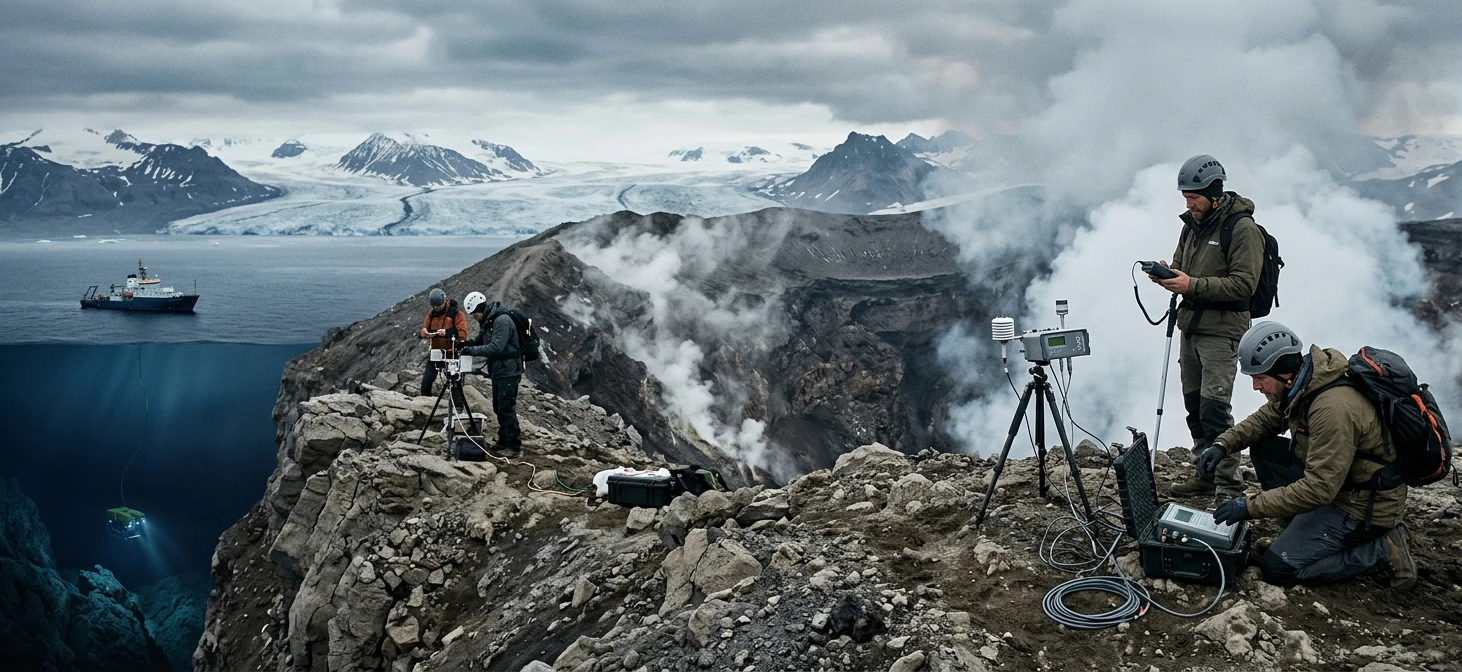
Some documentaries revisit history. Exploration documentaries move in the opposite direction. They follow people who are still walking into places that remain uncertain. That difference matters to me. Stories about exploration are rarely tidy. There is no clear ending, no moment when someone declares that the mystery has been solved. What these films capture instead is the moment when human curiosity collides with environments that refuse to reveal themselves easily. Despite satellites, drones, and global mapping, large parts of the planet are still poorly understood. Ocean trenches drop deeper than Mount Everest rises above sea level. Arctic ice shifts faster than researchers can document it. Archaeological chambers remain sealed for millennia before anyone finally opens them. The documentaries gathered here move through those frontiers. Some descend into volcanic craters. Others follow divers pushing the limits of the human body underwater. One film steps into the Arctic where ice has shaped entire ways of life. Taken together, these films remind me of something simple: the map may be detailed, but the world is far from finished.
Exploration Fields Covered in These Documentaries
| Documentary | Primary Theme | Exploration Focus |
|---|---|---|
| Into the Inferno (2016) | Nature / Exploration | Volcano research, geology |
| The Last Ice (2020) | Nature / Exploration | Arctic environment, polar research |
| Secrets of the Saqqara Tomb (2020) | History / Exploration | Archaeology |
| The Deepest Breath (2023) | Human Limits / Exploration | Freediving, deep ocean environments |
| Unknown: Cave of Bones (2023) | Science / Exploration | Paleoanthropology, cave exploration |
Five Documentaries That Go Where Maps Still Feel Incomplete
Into the Inferno (2016)
Werner Herzog does not approach volcanoes the way traditional science documentaries do. Instead of presenting them merely as geological phenomena, he treats them as forces that shape entire ways of life. Into the Inferno follows volcanologist Clive Oppenheimer across several volcanic regions, from Indonesia to Ethiopia and Iceland, observing how communities coexist with landscapes that can erupt without warning. What makes the film compelling is Herzog’s refusal to frame volcanoes as problems waiting to be solved. He is far more interested in the human responses they provoke. In some places volcanoes are tied to religious meaning, in others they represent constant risk, yet people continue living beside them. The imagery reinforces that tension. Rivers of lava crawl slowly across dark terrain while ash clouds swallow entire horizons. Human figures appear small against these environments. Watching the film, it becomes clear that exploration sometimes begins not with conquering nature, but with learning to stand quietly before its scale.
The Last Ice (2020)
The Arctic is often described as an empty wilderness, but The Last Ice dismantles that assumption almost immediately. The documentary focuses on the region scientists call the “Last Ice Area,” a section of the polar ocean long believed to be the most stable refuge for thick sea ice. Researchers once assumed that even as surrounding ice vanished, this zone would remain frozen far into the future. What makes the film compelling is the way it centers the Inuit communities who live within that landscape. For generations, sea ice has functioned as a road, a hunting ground, and a foundation for movement across vast distances. The ice is not scenery; it is infrastructure. Throughout the documentary, small shifts begin to appear. Cracks open earlier in the season. Familiar travel routes become unreliable. Hunters describe the unsettling feeling of recognizing a place that no longer behaves the way memory insists it should. Exploration here is not about discovering new territory. It is about witnessing a known world slowly transform.
Secrets of the Saqqara Tomb (2020)
Archaeology rarely resembles the dramatic treasure hunts that popular films tend to portray. Secrets of the Saqqara Tomb takes the opposite approach, following Egyptian archaeologists as they excavate a burial complex that remained sealed for more than four thousand years. The pace is patient and deliberate. Every layer of sand removed from the tomb reveals fragments of a story that has been waiting in silence since the Old Kingdom of ancient Egypt. What stands out in the documentary is the discipline of the excavation itself. Nothing is rushed. Walls are photographed before they are touched. Artifacts are cataloged carefully. Even the smallest detail receives attention because a misplaced movement could erase information that survived for millennia. As statues, painted reliefs, and burial objects begin to emerge, the emotional weight of the discovery becomes visible on the archaeologists’ faces. Exploration here is not about dramatic adventure. It is about patience, responsibility, and the quiet moment when the past finally becomes visible again.
The Deepest Breath (2023)
Unlike many exploration documentaries that rely on advanced technology, The Deepest Breath focuses on a discipline where the human body itself becomes the only equipment. The film follows Italian free diver Alessia Zecchini as she attempts to descend to extraordinary depths while holding a single breath. Each dive demands precise control over physiology, timing, and mental focus. The ocean environment in these sequences feels almost unreal. Sunlight fades quickly as divers sink deeper, leaving only blue darkness and the sound of movement through water. Without engines, lights, or mechanical noise, the ocean appears vast and indifferent to human ambition. The documentary gradually reveals the hidden network surrounding the sport. Safety divers track every descent, watching for the moment when oxygen deprivation might turn a record attempt into a rescue operation. As the story unfolds, the film shifts from a portrait of extreme athletic pursuit into something more unsettling. Exploration here is not about geography alone. It becomes a confrontation with the fragile limits of the human body.
Unknown: Cave of Bones (2023)
Some discoveries begin with satellite images or large expeditions. The story in Unknown: Cave of Bones begins in a narrow opening in the Rising Star cave system in South Africa. From the start, the documentary makes clear that this is not a typical archaeological site. The passages leading to the chamber are so tight that researchers must crawl, twist, and squeeze through spaces barely wider than their shoulders.
The film follows the team investigating remains of Homo naledi, a mysterious human relative first identified in the Rising Star caves, a discovery widely reported by National Geographic. Yet the documentary is less interested in academic debates than in the strange atmosphere of the place itself.
Inside the cave, light disappears quickly and the rock walls close in from every direction. Every movement feels deliberate. What unfolds is not a dramatic treasure hunt but something quieter: scientists working slowly inside a space that remained hidden for hundreds of thousands of years.
Why Exploration Documentaries Matter
Exploration documentaries endure because they challenge the comforting illusion that the world has already been fully understood. Modern technology often gives the impression that every landscape has been mapped and every mystery solved. Satellites photograph the planet continuously, and information travels instantly across continents. Yet these films reveal how incomplete that picture still is. Deep ocean trenches remain darker and less studied than the surface of the Moon. Arctic environments change faster than researchers can record them.Ancient structures continue to emerge from beneath desert sand after centuries of silence, discoveries frequently reported in archaeological research and publications such as Smithsonian Magazine’s archaeology coverage.Each of these environments reminds viewers that knowledge expands slowly, often through fragile and uncertain steps. What makes exploration documentaries particularly powerful is the perspective they provide. They place human curiosity beside forces that operate on entirely different scales — geological, climatic, or historical. Against those vast timelines, individual discoveries may seem small. Yet the drive behind them remains unmistakably human: the refusal to accept that the unknown should remain unexplored.
Those who find themselves drawn to these kinds of stories can continue exploring similar discoveries through the films gathered on the Movies page or the series featured in TV Series, where different corners of the world and the people who study them continue to appear on screen.